
Date: 8th November 2026
Put your training to work and compete for the absolute glory of being deemed ‘The Boss Of The Bay”!
A true test of determination and commitment, no one else to rely on but yourself, what’s better than that.
You do not need to qualify for this event! Simply choose your division and hit the ‘Register’ button below!
RegisterThere are 3 divisions for you to choose from; Advanced (Rx), Intermediate (Scaled) and Masters (40+).
The Advanced version of this event is for the more advanced athlete. It’s the perfect fit for athletes who love the thrill of competition and would typically complete daily workouts as they are prescribed
The Intermediate option is suited to those who are new to competing, share a common love of functional fitness and are working toward building strength and mastering their skills
We have a Masters category too. In fact, for any athlete aged 40 years or older, you will have the option of competing in the Masters category.
The below are batches of registrations – the sooner you register, the less you pay!
| 0-20 Rego's | 21-40 Rego's | 41-60 Rego's | 61-100 Rego's |
|---|---|---|---|
| --- | --- | $245>> | $255>> |

This event is called ‘Surf N Turf’
This is a swim/run event to get the body moving, the endorphins flowing and maybe spot a Dolphin or two! ALL athletes will start this event from Shark Net Beach where the mandatory briefing will take place at 0540 hours.
Now take a breath, and read on…
Advanced, Intermediate & Masters Athletes
For time, complete:
Time Cap: 45 minutes
Event Flow
At 3, 2, 1, athletes will take off on the 1km obstacle course. The course will wind through the beautiful Huskisson foreshore and feature a series of obstacles designed to challenge your agility, coordination and grit before returning to Shark Net Beach.
Once you cross through allocated markers, you’ll make your way directly to the swim entry point where you’ll complete a single 200m out across and back swim. Athletes should enter and exit the water via the designated entry lane, following all course markers and rounding the swim buoys as directed.
After exiting the water, competitors will immediately head back out onto the obstacle course to complete a second 1km lap. Your finishing time will be recorded as you cross the finish arches for the final time.
This event is completed continuously with no breaks, so pacing, efficient obstacle transitions and smooth water entry and exit will all play an important role in achieving a fast overall time.
Movement Standards
Athletes are permitted to wear wetsuits if they choose. Accessory devices such as floats, pull buoys, fins and hand paddles are not permitted.
Athletes are to swim out and around all of the designated buoys passing on their left.
There will be a huge water safety team in place so everyone can just focus on having fun!
The run will be a combination of beach, rock and concrete path and will be clearly marked. Athletes must run on the designated route at all times. Support vehicles and/or pacers are not allowed. Wearing headphones is not allowed.
The Obstacles may include features you have to climb over (around 4ft) as well as obstacles to crawl under.
For OH&S reasons communal foot baths will not be provided BUT, athletes are welcome to use their water bottle and/or towel to wash the sand off their feet if they so choose.
This event is called ‘That’s A Paddlin Vol.2’
The Kayak returns!
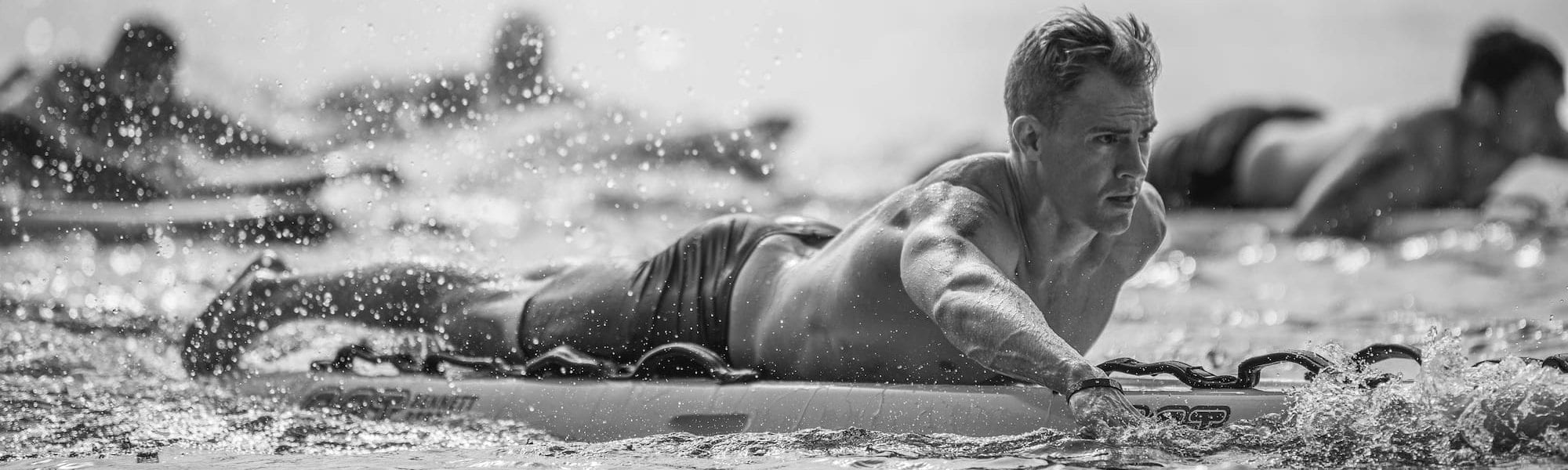
Time to get a paddling again, keeping these bad boys afloat and moving straight is key. Can you steer your ship, or will it be a paddlin.
Advanced Athletes
For time, complete:
300m Kayak Paddle
2 Rounds
300m Kayak Paddle
M: 24kg | F: 16-kg
*Tiebreak: completion of first Kayak Paddle
Time Cap: 15 minutes
Intermediate & Masters Athletes
For time, complete:
300m Kayak Paddle
2 Rounds
300m Kayak Paddle
M: 16kg | F: 12-kg
*Tiebreak: completion of first Kayak Paddle
Time Cap: 15 minutes
Movement Standards
Athletes must start in their designated holding pen/lane seated in their kayak.
Once the heat starts each Athlete must push off from the water’s edge and begin paddling towards the designated buoy. The athlete will paddle along the designated route at all times keeping the marker buoys on their right.
Once the athlete returns to the shore they must exit the water carefully, then carry their Kayak from the water back to their pen where they must gently lay it down.
NOTE: The Kayak’s are not to make contact with anything but sand, water and human. Penalties can be applied if an athlete causes a board to make contact with the metal crowd control barriers.
Athletes must pick up the kettlebells and carry along the designated course the required distance. Athletes must carry the kettlebells in the hand by the side throughout but may place bells down to rest as they need.
Kettlebell Thrusters (Single Arm)
Each set of kettlebell thrusters begins with the kettlebell on the ground. Athletes must clean the kettlebell up into the front rack position. From there athletes must squat down with kettlebell until their hip crease clearly goes below parallel with the top of the leg. Athletes must then drive the kettlebell overhead in one fluid motion. The rep is credited when both athletes have the kettlebell overhead with arms, hips and knees extended at the same time.
Kettlebell Hang Snatch (Single Arm)
The rep starts from the hang position. After the kettlebell is lifted off the floor, the athlete must pause with the kettlebell at the hang position, between the legs. From there, the athlete may perform a muscle snatch, power snatch, squat snatch, so long as the kettlebell comes up and DO NOT make contact with the shoulder while being lifted overhead. The rep finishes with the kettlebell directly overhead with arms, shoulders, knees and hips locked out.
At the bottom of the movement, the kettlebell may NOT touch the ground between repetitions. If they do, this will result in a “no rep” and the athlete must pass through the hang position again before starting the next repetition. The bell must be lifted overhead in one motion.
This event is called ‘Big Dawg’
Advanced, Intermediate & Masters
For load, in 5 minutes
Time Cap: 5 minutes
Event Flow
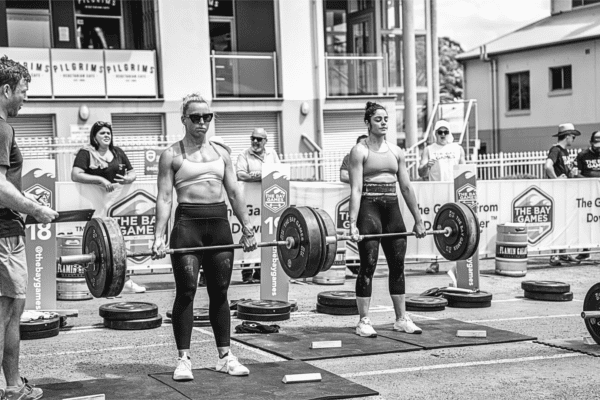
At 3, 2, 1, go athletes will step forward to their bar to complete a max weight attempt of the complex prescribed. Within 5 minutes athletes may have as many attempts as they like to set a heaviest weight (bars can be preloaded before the timer starts).
You may go down in weight if you choose. Remember to always wait for your judges down call or you will receive a no rep for that attempt. Touch and go style is permitted on the hang clean so long as you reach a proper standing lockout position on each rep before descending the bar. Not stopping to show control of the clean at the top will also result in a no rep.
Movement Standards
Each rep, the barbell must begin on the ground. Athletes then perform a clean, taking the bar from the ground to the front rack position. Athletes may choose to do a squat or power style clean.
The rep is credited when the barbell is in the front rack with the bar making contact with the torso and elbows in front of the barbell with the athlete’s hips and legs extended. If the feet have moved out during the lift they must be recovered to the width of hands as a minimum.
Hang Clean
The Hang Clean begins with the bar touching the mid thigh with arms straight and ends with the bar touching both shoulders in the “Front Rack” position with the elbows in front of the barbell. Athletes may receive the bar at any height (power or squat) but must stand up the bar fully with hips and knees locked out before the rep is awarded.
Each rep begins with the barbell in the front-rack position and the bar in contact with the torso.
The rep is credited when the barbell is fully locked out overhead with the athletes arms, hips, and legs extended. The feet must be in line under the body and the bar must be over the centre of the athlete’s body when viewed from profile (aka the side).
A press, push press, push jerk or split jerk are permitted as long as the athlete reaches the required finish position.
This event is called ‘DOUBLE SHIFT’
Advanced Individuals
In 13 minutes, complete as many rounds as possible of:
Part A: 6 minutes
10 Cals Row Erg
6m Dumbbell Lunges
6 Burpees Over Dumbbell
6m Dumbbell Lunges
M: 22.5kg | F: 15kg
Rest 1 minute
Part B: 6 minutes
10 Cals Echo Bike
5 Deadlifts
5 Cleans
5 Shoulder to Overhead
M: 65kg | F: 45kg
Intermediate Individuals & Masters Individuals
In 13 minutes, complete as many rounds as possible of:
Part A: 6 minutes
10 Cals Row Erg
6m Dumbbell Lunges
6 Burpees Over Dumbbell
6m Dumbbell Lunges
M: 15kg | F: 10kg
Rest 1 minute
Part B: 6 minutes
10 Cals Echo Bike
5 Deadlifts
5 Cleans
5 Shoulder to Overhead
M: 45kg | F: 30kg
Event Flow
At 3, 2, 1, go athletes will begin on their allocated section. Some divisions will start with Part A and others will start with Part B, however all athletes will complete both parts.
Each part is a separate six-minute AMRAP with a one-minute rest and transition between them. Part A and Part B will be scored separately.
For Part A, athletes must complete 10 calories on the Row Erg before moving on to the dumbbell lunges, burpees and return lunges. Once the full round is complete, athletes will return to the Row Erg and begin the next round.
For Part B, athletes must complete 10 calories on the Echo Bike before moving on to the deadlifts, cleans and shoulder to overhead. Once the full round is complete, athletes will return to the Echo Bike and begin the next round.
Each completed calorie and movement repetition counts toward the athlete’s score for that part. Each completed 6m lunge length is worth six repetitions. A 3m line will be used to award three repetitions for a partially completed length when time expires.
Movement Standards
Each round begins with 10 calories on the Row Erg. Athletes must complete all 10 calories before advancing to the dumbbell movements.
The monitor will continue accumulating calories throughout the six-minute AMRAP. Any completed calories from an unfinished round will count toward the athlete’s Part A score.
Athletes will use one dumbbell, which may be held in any position while completing walking lunges over the marked 6m course.
For each lunge, the trailing knee must make contact with the ground and the athlete must stand to full extension through the hips and knees before continuing into the next step.
The athlete must cross the 6m line to receive all six repetitions. If time expires after the athlete has crossed the marked 3m line, they will receive three repetitions.
The athlete must be positioned laterally to the dumbbell.
Each rep begins with the athlete lowering to the ground until their chest and thighs make contact with the ground.
The athlete must then return to their feet and jump laterally over the dumbbell. A two-foot take-off is not required, however both feet must be off the ground at the same time while passing over the dumbbell. Stepping over the dumbbell is not permitted.
The rep is credited once the athlete has passed over the dumbbell and landed on the opposite side.
Each round begins with 10 calories on the Echo Bike. Athletes must complete all 10 calories before advancing to the barbell movements.
The monitor will continue accumulating calories throughout the six-minute AMRAP. Any completed calories from an unfinished round will count toward the athlete’s Part B score.
Each rep begins with the barbell on the ground. Athletes must lift the barbell until they are standing with their hips and knees fully extended, shoulders behind the bar and the barbell under control.
The rep is credited when the athlete reaches the fully extended position.
Each rep begins with the barbell on the ground. Athletes may perform either a power clean or squat clean.
The rep is credited when the barbell is in the front rack position, with the bar making contact with the torso, the elbows in front of the bar and the athlete’s hips and knees fully extended.
Each rep begins with the barbell in the front rack position. Any shoulder-to-overhead technique is permitted, including a strict press, push press, push jerk or split jerk.
The rep is credited when the barbell is fully locked out overhead with the athlete’s arms, hips and knees extended. The feet must be in line underneath the body and the barbell must be positioned over the centre of the athlete’s body when viewed from profile.
This event is called ‘Wormhole’
Advanced Individuals
In 6 minutes, complete as many rounds as possible of:
4 Sandbag Cleans
4 Sandbag Squats
2 Rope Climbs to 15ft
M: 70kg | F: 50kg
Intermediate & Masters Individuals
In 6 minutes, complete as many rounds as possible of:
4 Sandbag Cleans
4 Sandbag Squats
2 Rope Climbs to 12ft
M: 50kg | F: 35kg
Event Flow
At 3, 2, 1, go athletes will begin working through the movements in the order listed.
Athletes must complete all four sandbag cleans, four sandbag squats and two rope climbs before returning to the sandbag to begin the next round.
Each completed sandbag movement and successful rope climb counts as one repetition. The athlete’s score will be the total number of repetitions completed within six minutes.
Movement Standards
Each rep begins with the sandbag on the ground. Athletes must lift the sandbag from the ground and bring it onto one shoulder.
Athletes may use any technique to bring the sandbag to the shoulder.
The rep is credited when the athlete is standing with their hips and knees fully extended and the sandbag is under control on the shoulder.
The sandbag must be held on one shoulder throughout the squat. Athletes are not required to alternate shoulders between repetitions or rounds.
Each rep begins with the athlete standing with their hips and knees fully extended. The athlete must then squat until their hip crease passes below the top of the knee.
The rep is credited when the athlete returns to a standing position with their hips and knees fully extended and the sandbag under control on the shoulder.
Each rope climb begins with the athlete on the ground. The rep is credited when the athlete reaches the required height and touches the marked target with one hand.
Advanced athletes will climb to 15ft. Intermediate and Masters athletes will climb to 12ft.
Athletes are not required to maintain control of the rope until they reach the ground, however all descents must be completed safely.

Every 30 seconds, a person in Australia reaches out to Lifeline for help
They are a national charity providing all Australians experiencing emotional distress with access to 24 hour crisis support and suicide prevention services
They exist so that no person in Australia has to face their darkest moments alone
Sign up to our weekly email and discover what's happening here at Bay Games HQ. We promise to never sell or share your information as, that would be rude!